
Different HYROX Training Plans: The Complete Guide for Every Athlete 2026
HYROX is not your average race. It’s 8 rounds of 1km running followed by a functional workout station — Ski Erg, Sled Push, Sled Pull, Burpee Broad Jumps, Row Erg, Farmers Carry, Sandbag Lunges, and Wall Balls — all done for time, indoors, in a standardized format that’s identical worldwide.
That consistency is both what makes HYROX so compelling and what makes training for it so specific. You can’t just “get fit” and show up. You need a dedicated HYROX training plan that builds your running endurance, functional strength, and the hybrid conditioning that HYROX demands simultaneously.
Whether you have 4 weeks or 24 weeks before your race, this guide breaks down every major type of HYROX training plan, what each one includes, who it’s best for, and how to pick the right one for your goal.
What Makes HYROX Training Plans Different from Regular Fitness Training?
Most gym programs optimize for one thing — strength, hypertrophy, or cardio. HYROX demands all three at once, in a fatigued state.
A dedicated HYROX training plan trains you to:
- Run under fatigue — your legs are already burning from sled pushes when you hit the next 1km
- Maintain workout form when gassed — wall ball technique breaks down fast at 70% heart rate
- Pace across 60–120+ minutes — energy management is a skill, not an afterthought
- Build station-specific strength — Ski Erg pulls, sled mechanics, and sandbag carries are not standard gym movements
This is why a generic CrossFit plan or marathon plan won’t prepare you properly. You need structure that mimics the race demands.
Overview: Types of HYROX Training Plans
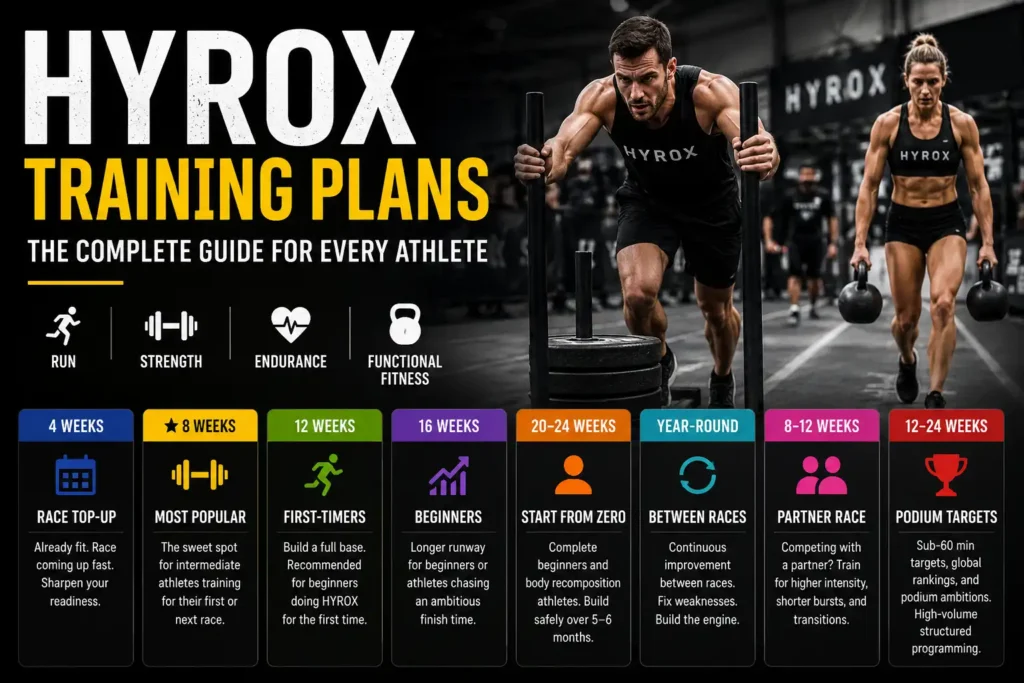
📅 Choose your HYROX training plan
| Plan Type | Duration | Best For |
|---|---|---|
| 4-Week Plan | 4 Weeks | Race top-up, already-fit athletes |
| 8-Week Plan | 8 Weeks | Most popular, intermediate athletes |
| 12-Week Plan | 12 Weeks | First-timers, building full base |
| 16-Week Plan | 16 Weeks | Beginners or ambitious time goals |
| 20–24 Week Plan | 5–6 Months | Complete beginners, body recomposition |
| Off-Season Plan | Year-round | Continuous improvement between races |
| Double HYROX Plan | 8–12 Weeks | Competing in the doubles category |
| Pro/Elite Plan | 12–24 Weeks | Podium and sub-60 min targets |
1. The 4-Week HYROX Training Plan
The 4-week plan is a race-prep sharpener, not a base builder. If you’re already training consistently — running 3+ times a week, doing gym sessions regularly — this plan takes your existing fitness and channels it specifically into HYROX performance.
What It Covers:
- Race simulation sessions (run + station combos)
- Station-specific skill work (sled technique, Ski Erg pacing)
- Taper week in week 4
- Zone 2 running maintenance
Who It’s For:
- Athletes who’ve raced HYROX before and are prepping for their next event
- Crossfitters or runners with solid conditioning who just registered for their first race
- Anyone returning from a short break who needs to sharpen up
What to Expect:
4 training days per week, with at least one full HYROX simulation workout. Sessions run 45–75 minutes. Volume is kept moderate since there isn’t time to recover from accumulated fatigue before race day.
→ Download the full HYROX 4-Week Training Plan PDF with day-by-day programming, pacing targets, and station rep schemes.
2. The 8-Week HYROX Training Plan
The 8-week plan is the most popular HYROX training timeline for a reason — it’s long enough to build meaningful fitness improvements and short enough to stay motivated all the way through.
This is the sweet spot for intermediate athletes and the most commonly recommended plan for first-time HYROX racers who already have a reasonable fitness base.
What It Covers:
Weeks 1–2: Foundation Running base work, light station introductions, aerobic conditioning. Getting the body used to back-to-back run-station efforts.
Weeks 3–5: Build Increased station loads, longer simulation workouts, tempo running, lactate threshold work. This is where the real HYROX-specific conditioning happens.
Weeks 6–7: Peak Full HYROX simulations, race-pace efforts, high-intensity station work. Maximum training load.
Week 8: Taper Volume drops significantly. Light runs, short station practice, race prep and mental rehearsal.
Training Structure (Typical Week):
- Day 1: Running intervals + Ski Erg / Row Erg
- Day 2: Strength — Sled, Farmers Carry, Sandbag Lunges
- Day 3: Active recovery or Zone 2 run
- Day 4: Full HYROX simulation (scaled)
- Day 5: Rest or mobility
Who It’s For:
- First-time HYROX racers with 3–6 months of consistent training
- Gym-goers transitioning into competitive fitness
- Athletes targeting a sub-90-minute finish
→ Get the complete day-by-day program in our HYROX 8-Week Training Plan PDF — includes sets, reps, pacing zones, and weekly benchmarks.
3. The 12-Week HYROX Training Plan
The 12-week plan is the gold standard for first-time HYROX athletes who want to race with confidence, not just survive. Three months gives you enough time to genuinely build your aerobic base, dial in station technique, and peak properly before race day.
This plan is structured in three distinct phases, each with a clear physiological purpose.
Phase 1 — Weeks 1–4: Aerobic Base & Station Introduction
- Easy Zone 2 running 3x per week (20–40 min)
- Introduction to all 8 HYROX stations with technique focus
- Light loads, high reps — learn the movements before loading them
- Full body strength work 2x per week
Phase 2 — Weeks 5–8: Strength & Conditioning Build
- Running transitions to tempo and threshold intervals
- Station loads increase progressively
- Race-specific combos introduced (e.g., 1km run → Sled Push → 1km run)
- First full mock HYROX in week 7 or 8 (scaled weights/volume)
Phase 3 — Weeks 9–11: Race Sharpening
- Peak intensity and volume
- Full HYROX simulations at target race pace
- Station-specific weak point work
- Mental rehearsal and race strategy
Week 12: Taper
- Volume cut by 40–50%
- Short, sharp sessions only
- Focus on sleep, nutrition, and race logistics
Who It’s For:
- Complete HYROX beginners with a moderate fitness base
- Athletes targeting a specific finish time
- Anyone who wants a structured, progressive approach rather than guessing
→ Follow along with the exact week-by-week breakdown in our HYROX 12-Week Training Plan PDF.
4. The 16-Week HYROX Training Plan
If you have four months before race day, you have a genuine advantage. The 16-week plan allows for a full base-building phase before you even touch race-specific work — meaning your peak is higher and your taper is more effective.
This plan suits beginners who are starting from a lower fitness base or intermediate athletes who have ambitious time goals (sub-75 minutes, sub-60 minutes).
Structure Overview:
- Weeks 1–4: Aerobic base + movement patterns. No race simulation yet.
- Weeks 5–8: Introduce HYROX-specific conditioning. Station loads begin to climb.
- Weeks 9–12: Build phase. Race simulations, interval running, heavy station work.
- Weeks 13–15: Peak phase. Highest intensity. Full race simulations at target pace.
- Week 16: Taper and race day.
Key Difference from 12-Week:
The extra month is used entirely in the early phases — building a bigger aerobic engine before the race-specific work starts. Athletes who follow a 16-week plan consistently report better endurance in the back half of races (stations 5–8 and runs 6–8).
→ Pair this with our HYROX Training Equipment List to make sure you have everything you need before week one.
5. The 20–24 Week HYROX Training Plan (Beginner)
If you’re starting from scratch — little running background, new to functional fitness, or returning after a long break — a 20 to 24-week plan gives you the runway to build safely and arrive at race day genuinely prepared.
Rushing base fitness is the number one reason beginners have a bad race experience. Going out too hard on the sled, cramping on run 6, or failing to finish wall balls — these outcomes are avoidable with proper preparation time.
What This Plan Prioritizes:
- Months 1–2: Build a running base from zero. Walk-to-run protocols if needed. Bodyweight strength.
- Months 3–4: Introduce HYROX stations with light loads. Start combining runs with station work.
- Month 5: HYROX-specific conditioning. First full mock race.
- Month 6: Peak, sharpen, taper, race.
Who It’s For:
- Complete beginners to both running and functional fitness
- People who’ve been sedentary and want HYROX as a goal to work toward
- Athletes recovering from injury who need a gradual return to load
6. The Off-Season HYROX Training Plan
HYROX athletes who race more than once a year need a structured off-season plan to maintain fitness, address weaknesses, and arrive at their next race better than their last.
The off-season is not the time to grind race-specific work — it’s the time to fill the gaps.
What an Off-Season Plan Focuses On:
- Strength development — heavier lifting, more rest between sets, building absolute strength that carries into race performance
- Aerobic base building — high volume Zone 2 running without the race pressure
- Weak station drilling — if Ski Erg or Wall Balls are your weak points, the off-season is when you fix them
- Mobility and recovery — reducing injury risk and fixing imbalances
- Cross-training — cycling, swimming, rowing as active recovery that still builds the engine
Structure:
Typically 3–4 days per week, split between strength-focused sessions and aerobic maintenance. No race simulations. No taper weeks. Just consistent, progressive work.
7. The HYROX Doubles Training Plan
Competing in the HYROX Doubles category (two athletes sharing the work) requires a slightly different training approach. You’re doing half the running and half the stations — but you’re doing your half at a significantly higher intensity since you have more recovery time between efforts.
What Changes in Doubles Training:
- Shorter but higher-intensity station work (you go all-out on your portion)
- Partner transition practice — knowing when to tag in and out
- Running pace is faster since you’re doing 4 x 1km at near-max effort rather than 8 x 1km at controlled pace
- Communication and strategy with your partner matters
Training Approach:
Train individually using a standard 8-week or 12-week plan structure, but modify simulations to mirror the doubles format. Run 4 x 1km intervals at a harder pace. Do 4 stations at race intensity with full rest between.
Also spend time training the handoff moments — the 30 seconds before and after a station where your partner transitions is where time is won or lost.
8. The Elite / Pro HYROX Training Plan
For athletes targeting podium finishes, top-100 worldwide rankings, or sub-60-minute times, an elite training plan looks fundamentally different from a beginner or intermediate program.
Elite HYROX athletes typically train 6 days per week across 3 sessions per day (morning, lunch, evening) during peak blocks. This is not appropriate for recreational athletes.
What Elite Programming Includes:
- Two-a-day sessions during peak blocks
- Highly specific power-endurance work — not just “do the station” but track pace-per-meter on Ski Erg, split times on Row Erg, sled push intervals
- Running volume of 60–80km per week during peak phase
- Strength work that stays sport-specific — weighted sled variations, Ski Erg resistance work, loaded carry progressions
- Race strategy and mental performance coaching
- Detailed nutrition and recovery protocols
Who It’s For:
Athletes who have already completed multiple HYROX races, have sub-75-minute times, and are ready to make HYROX a serious pursuit.
How to Choose the Right HYROX Training Plan
Use this simple decision framework:
→ Race is in 4 weeks or less + you’re already fit: 4-Week Plan
→ Race is in 6–10 weeks + intermediate fitness: 8-Week Plan
→ Race is in 10–14 weeks + first-timer or ambitious goal: 12-Week Plan
→ Race is in 14–18 weeks + lower base or time goal: 16-Week Plan (coming soon)
→ Race is 5–6 months away + starting from scratch: 20–24 Week Beginner Plan (coming soon)
→ Between races, no upcoming event: Off-Season Plan (coming soon)
→ Competing with a partner: Doubles Plan (coming soon)
What Equipment Do You Need for These Training Plans?
Regardless of which plan you follow, you’ll need access to specific equipment to train the HYROX stations properly. The good news is that most commercial gyms carry the essentials, and you can replicate several stations at home with the right gear.
Essential HYROX Training Equipment:
- Ski Erg — for station 1 and aerobic conditioning
- Sled (push + pull) — for stations 2 and 3
- Rowing Machine (Concept2) — for station 5
- Kettlebells / Dumbbells — for Farmers Carry (station 6)
- Sandbag — for Sandbag Lunges (station 7)
- Wall Ball — for station 8
- Pull-up / anchor point — for sled pull rope simulation
→ See the complete breakdown with recommended weights by division in our HYROX Training Equipment List.
Weekly Training Structure: What a Typical HYROX Week Looks Like
Regardless of which plan length you choose, most HYROX training weeks follow this general structure:
| Day | Focus |
|---|---|
| Monday | Running intervals + Ski Erg or Row Erg |
| Tuesday | Strength — Push/Pull stations + accessory work |
| Wednesday | Zone 2 run (30–50 min) or rest |
| Thursday | HYROX simulation — 4–8 stations + runs |
| Friday | Weak point work + short run |
| Saturday | Long run or full mock HYROX |
| Sunday | Full rest or mobility |
The simulation session is the most important session of the week. It’s where your body learns to deal with the exact demands of race day — running under muscular fatigue, pacing stations, and managing heart rate.
HYROX Training Plan FAQs
Q1: How many days a week should I train for HYROX?
For most athletes, 4–5 training days per week is the sweet spot. Less than 4 days doesn’t give enough stimulus for meaningful progress. More than 5 days without proper recovery experience leads to accumulated fatigue, especially given the hybrid nature of HYROX training which taxes both your cardiovascular system and your muscles simultaneously. Beginners should start at 3–4 days and build up. Elite athletes may train 6 days.
Q2: Can I use a running plan or CrossFit plan for HYROX?
You can use them as a base, but they won’t prepare you fully. A running plan builds your aerobic engine but won’t prepare you for the station demands. A CrossFit plan builds functional strength but rarely has the running volume or specific HYROX station work needed. A dedicated HYROX plan is built around the specific demands of the race — you’ll always perform better with targeted preparation.
Q3: I’ve never run more than 5km. Can I do HYROX?
Yes — but give yourself time. A HYROX race involves 8km of total running broken into 1km segments. If your current long run is 5km, you’d benefit from a 16-week or 20-week plan that builds your running base before diving into the full race-specific work. The segmented nature of HYROX actually makes it more accessible than a straight 8km run since you get brief recovery between running segments.
Q4: What’s more important for HYROX — running or gym fitness?
Both matter, but most recreational athletes are limited more by their running than their gym fitness. The running in HYROX is continuous, cumulative, and done in a fatigued state. A good rule of thumb: if your 5km time is over 30 minutes, prioritize running. If you can’t complete the station weights, prioritize gym work. Ideally, your training plan addresses both simultaneously.
Q5: How do I know which HYROX division to enter?
HYROX has several divisions: Open (lighter weights), Pro (heavier weights), Elite 15, and age-group categories. Most first-timers enter Open. If you’re a competitive CrossFit athlete or experienced strength athlete, Pro may suit you. Check the official HYROX website for exact weight requirements per division and compare against what you can currently move for high reps.
Q6: Should I do a full HYROX simulation before race day?
Yes — at least once, ideally twice. A full simulation helps you understand your pacing, identify which stations slow you down, and experience the mental challenge of the back half of the race (stations 6, 7, and 8 after 6km of running). Most 8-week and 12-week plans include at least one scaled simulation and one near-full simulation before taper week.
Q7: How important is the taper week before HYROX?
Very important, and often underestimated. Many athletes keep training hard right up to race day out of anxiety about losing fitness. In reality, fitness built over weeks doesn’t disappear in 7 days — but accumulated fatigue does clear. A proper taper (volume cut by 40–50% in the final week) means you arrive at race day with full glycogen stores, recovered muscles, and a fresher nervous system. Trust the taper.
Q8: Can I train for HYROX at home without a gym?
Partially. You can do running, sandbag lunges, wall balls (with a soft ball and wall), and Farmers Carry with kettlebells at home. The Ski Erg, Sled, and Row Erg require gym access. If you don’t have access to these machines, substitute Ski Erg with banded pull-downs or cable pull-downs, and replicate sled pushes by pushing heavy furniture or using a resisted sprint band. It’s not perfect — but it’s better than skipping those stations entirely.
Q9: What should I eat during HYROX training?
HYROX training is high-volume and hybrid in nature, so your nutrition needs to support both endurance and strength adaptation. Prioritize adequate protein (1.6–2.2g per kg of bodyweight), enough carbohydrates to fuel training sessions, and sufficient calories overall. Don’t under-eat during peak training weeks — your body needs fuel to adapt. On race day specifically, aim for a carbohydrate-rich meal 2–3 hours before start, and consider electrolytes during the race.
Q10: How long does it take to complete a HYROX race?
Finish times vary widely by division and fitness level. Most recreational athletes in the Open division finish between 75 and 120 minutes. Competitive athletes target sub-75 or sub-60 minutes. Elite athletes finish in under 55 minutes. Your training plan should include some race-pace simulation so you understand what sustainable pace feels like across the full distance.
Q11: Do I need a HYROX-specific coach or is a training plan enough?
For most athletes, a well-structured training plan is sufficient, especially with good adherence and honest self-assessment. A coach adds value if you’re targeting elite times, have persistent weak areas you can’t fix alone, or you want accountability and real-time feedback. Start with a plan and add coaching if you feel you’ve maxed out what you can do independently.
Final Thoughts
There’s HYROX training plans for every timeline, every fitness level, and every goal. The key is choosing the right one for where you actually are — not where you wish you were — and then following it with consistency.
The athletes who race HYROX well aren’t necessarily the strongest or the fastest. They’re the most prepared. They’ve practiced the stations. They’ve trained the transitions. They’ve run under fatigue. They’ve done a mock race. They know their pace.
That preparation starts with a plan.
→ Start with our most popular option: the HYROX 8-Week Training Plan PDF
→ New to HYROX? Begin with the HYROX 12-Week Training Plan PDF
→ Short on time? The HYROX 4-Week Training Plan PDF gets you race-ready fast
→ Gear up first: HYROX Training Equipment List